Marketing communication

Murray Income Trust Plc Q2 2026 update





Source for all information: Artemis as at 30 June 2026, unless otherwise stated.
CAPITAL AT RISK. All financial investments involve taking risk and the value of your investment may go down as well as up. This means your investment is not guaranteed and you may not get back as much as you put in. Any income from the investment is also likely to vary and cannot be guaranteed.
This is a marketing communication. Before making any final investment decisions, and to understand the investment risks involved, refer to the Pre-Investor Disclosure Document, Articles of Association and KID, available in English, available in the literature library.
Objective
The investment company aims to achieve a high and growing income combined with capital growth through investment in a portfolio principally of UK equities.
Portfolio transition
In the weeks following our appointment as manager of the Murray Income Trust plc on 2 March 2026, we reorganised the portfolio so that by 1 April, it replicated our long-standing Artemis Income strategy.
Despite stock market volatility in the weeks leading up to that point, we completed the portfolio transition within the timeframe and below the costs we had anticipated.
What has changed?
- We believe the portfolio is more balanced and diversified than before, even though our top 10 holdings account for a larger proportion of the portfolio
- The portfolio is attractively valued relative to the wider UK stockmarket1
- The trust has greater exposure to UK companies, and while this could change over time, it reflects where we see the best returns potential for the time being
The trust’s top 10 positions, shown before and after the transition, are listed below.
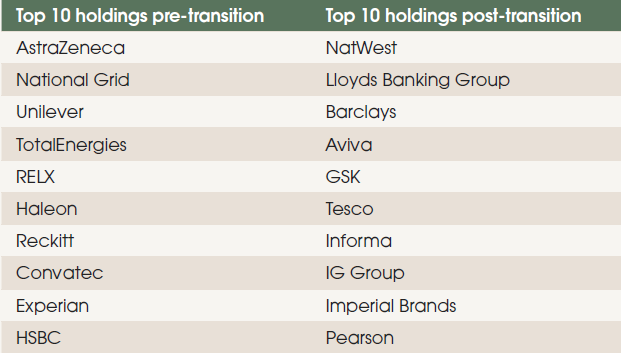
Source: Murray Income Trust PLC, Artemis, pre-transition holdings as at 28 February 2026 and post-transition holdings as at 30 June 2026
Performance
Artemis spent a month transitioning the portfolio, so that by 1 April (the start of the second quarter of 2026) its holdings were aligned with the Artemis Income strategy. In the three months from then until 30 June 2026, the trust’s net asset value (NAV) increased by 9.1% and its share price rose by 11.5%. The trust’s benchmark, the FTSE All-Share index, gained 4.7%2.
Performance to 30 June 2026
| Three months (since transition*) | Six months | One year | Three years | Five years | |
|---|---|---|---|---|---|
| Murray Income Trust plc (NAV) | 9.1% | 6.1% | 14.3% | 29.8% | 36.5% |
| Murray Income Trust plc (share price) | 11.5% | 9.0% | 19.2% | 33.8% | 39.3% |
| FTSE All-Share index TR | 4.7% | 7.2% | 21.9% | 53.1% | 67.9% |
Past performance is not a guide to the future.
Source: Lipper Limited/Artemis to 30 June 2026. All figures show total returns with dividends and/or income reinvested, net of all charges. Performance does not take account of any costs incurred when investors buy or sell the trust. Returns may vary as a result of currency fluctuations if the investor's currency is different to that of the class.
*Artemis assumed management of the trust on 2 March 2026. From that date to 30 June 2026, the trust’s NAV return was -1.2%, its share price return was -0.4% and the FTSE All-Share index returned -2.3%. The trust’s portfolio was transitioned to the Artemis Income strategy by 1 April 2026.
Performance for the past five years, prior to Artemis assuming investment management (%):
| Calendar year performance** | 2025 | 2024 | 2023 | 2022 | 2021 |
| Murray Income Trust plc (NAV) | 14.7 | 2.2 | 9.0 | -6.0 | 18.8 |
| Murray Income trust plc (Share Price) | 16.9 | -1.2 | 7.3 | -4.1 | 14.1 |
| FTSE All-Share Index TR | 24.0 | 9.5 | 7.9 | 0.3 | 18.3 |
Past performance is not a guide to the future
Source: Lipper Limited/Artemis to 31 December 2025. NAV figures show total returns with dividends reinvested, net of all charges. Performance does not take account of any costs incurred when investors buy or sell the trust. Returns may vary as a result of currency fluctuations if the investor's currency is different to that of the class.
**Artemis assumed management of the trust on 2 March 2026.
Contributors
The trust’s best-performing holdings during the three months to 30 June 2026 included IG Group, Informa, Pearson, Segro and easyJet. We also benefited from being underweight3 energy, as oil producers performed poorly after an albeit tenuous ceasefire in Iran was announced.
Shares in the online trading platform IG Group hit an all-time high4 after a positive May trading update5. We believe IG Group’s relatively new management team, who have been in situ since 2024, have improved the company’s culture. This is feeding through into better performance for the business, which has grown its sales and customer base.
IG announced a strategic review in March “to make sure IG maximises shareholder value”, according to chief executive officer Breon Corcoran6. This has been well received by investors.
Informa’s share price fell earlier this year due to concerns about its events in the Middle East, but it recovered significantly during June. We think Informa is under-appreciated and perhaps even misunderstood by other market participants. It is the global leader in business-to-business events and has grown from 10 trade fairs 12 years ago to a portfolio of more than 800 brands7. Not only are its events extremely profitable, but they produce large amounts of valuable and unique first-party data. Having invested in its technology, Informa is using this data to improve customer service and generate sales leads.
Pearson shares continued their recovery after a difficult spell in February when the company appeared to have been added to the ‘AI loser’ basket. We think the opposite. Pearson is one of relatively few businesses that could benefit from the integration of AI into its offering, thanks to its ownership of difficult-to-replicate proprietary data. We see Pearson’s assessments and qualifications business as especially valuable, in a world that requires ever more proof and verification. Pearson has also been buying back a significant amount of its own shares8.
Segro, a real estate investment trust (REIT), performed strongly following an unsolicited bid from US logistics giant Prologis. Segro’s board raised a robust defence, highlighting numerous avenues for value creation.
EasyJet's shares rallied after the airline was approached by US private equity firm Castlelake. EasyJet rejected Castlelake’s first four proposals before agreeing in principle to a sweetened offer in early July. Apollo Global Management then entered the race on 8 July with a higher bid, which easyJet has backed9. Our view (for some time) has been that easyJet’s shares are materially undervalued, trading below the replacement cost of its fleet of planes, and ascribing no value to easyJet holidays, its brand and its slots at capacity-constrained airports. We are reassured to see more widespread recognition of this through Castlelake and Apollo’s approaches.
The bids for Segro and easyJet are testament to how cheap and undervalued some parts of the UK stockmarket have become, in our view. There are several more companies in our portfolio that we believe could be vulnerable to an approach. Merger and acquisition activity should help to underpin share prices going forward, as bid approaches once again seem to be ticking up for UK companies.
Detractors
Imperial Brands published a weaker-than-expected trading update for the first half of its 2026 financial year10 and its shares responded. Although the tobacco sector is not without risks, we think a lot of the downside is already priced in (i.e. we believe Imperial’s shares are cheap). The company generates a lot of cash, which it is returning to shareholders through dividend11 payments and share buybacks.
Medical technology company Smith & Nephew also performed poorly during the quarter. We think other investors and analysts are focusing too much on its admittedly challenged orthopaedics business. Its other divisions – sports medicine and wound management – are high-quality, high-margin businesses that are among the market leaders. As these two divisions continue to grow, we expect them to account for an ever-larger proportion of group sales, profits and cashflows.
Tesco shares declined in May, largely in response to competitive pressures. We believe Tesco possesses the scale, balance sheet and management team to remain the market leader. Its command of technology is a particular advantage, and we think the value of its Clubcard data is significantly underestimated.
Activity
We initiated a holding in Reckitt, the multinational consumer goods company, during the quarter. Its share price had fallen sharply in reaction to conflict in the Middle East, so we were able to purchase shares at an attractive valuation and a dividend yield12 approaching 5%. We believe Reckitt’s portfolio of brands offers long term growth potential, and we see the significant proportion of revenue it derives from emerging markets as positive.
Why cashflow is our North Star
Since reorganising the trust’s portfolio in March, we have made few changes. This is very much in keeping with our long-term approach; our income strategy has an average holding period of more than eight years so we are genuinely long-term investors.
When we do make changes to our portfolio, they are usually driven by our focus on cashflow. This is the cash that a company generates for its shareholders after all costs, taxes and necessary investment, the latter being of the utmost importance.
It is our assessment of the amount, sustainability and duration of this cashflow that underpins the reasons we invest in a company and that can lead us to reduce or fully exit a holding.
But this is an income-focused investment trust; shouldn’t our primary interest be in dividends?
The answer is yes, but the dividend is a discretionary decision taken by the board. ‘Good’ dividend decisions and policies need to be underpinned by the cashflow a company generates. This is why our focus is on cashflow first, dividends second.
Some income investors begin their analysis of a company with its dividend yield and work their way backwards. We believe such a strategy is fallible because investors could potentially be swayed by an attractive yield, even without being fully satisfied that the company has the cashflow credentials to sustain and grow its dividend going forward.
Tesco (which is one of the trust’s top 10 holdings) offers a great example of what we are looking for. We often say that our “Holy Grail” is a 4% yield growing at 5% per annum; this retailer has delivered this outcome over the past five years. Moreover, Tesco generates roughly twice as much cash as is needed to pay this dividend.
As it happens, Tesco has decided to use this extra cash to purchase its own shares; the number of Tesco shares trading on the stockmarket – its ‘share count’ – has fallen by 17% over the past five years13. This concentrates any future cashflows among a smaller number of existing shareholders. Meanwhile, it has grown its underlying business, increasing its share of the UK grocery market to 28.5% today14.
Although we prioritise cashflows over dividends, the current environment means this focus does not come at the expense of the income investors receive. Murray Income Trust is currently yielding 4.1%, compared with the 3.1% offered by the FTSE All-Share index15.
As the market becomes even shorter-term in nature, we believe longer-term investors can prosper by investing in companies with strong and sustainable competitive advantages. We see this as a more assured and long-term way of creating value, as opposed to trying to second guess the next twist or turn in politics or the economy.
Notes and references
1 The trust’s portfolio has a price-to-earnings multiple of 11.9x. This is cheaper than the trust’s benchmark, the FTSE All-Share index, on 12.8x (source: Artemis as at 30 April 2026).
2 The FTSE All-Share Index is a widely-used indicator of the performance of the UK stockmarket, in which the trust invests. It acts as a ‘comparator benchmark’ against which the trust’s performance can be compared. Management of the trust is not restricted by this benchmark. The deviation from the benchmark may be significant and the portfolio, performance and volatility of the trust may at times bear little or no resemblance to its benchmark.
3 Being 'underweight' is when a fund has a lower percentage weighting in an asset class, stock, sector or geographical region than the index or benchmark against which it is measured. For example, if a fund has a 4% weighting in the technology sector, but its benchmark has a 6.5% weighting, the fund is 2.5% underweight.
4 https://www.marketwatch.com/story/ig-group-shares-hit-all-time-high-on-guidance-raise-bf46ec31
Share buybacks, also known as share repurchases, refer to the reacquisition by a company of its own shares. Instead of paying dividends, it is an alternative way for a company to return money to shareholders. In most countries, a company is able to repurchase its shares by paying cash to existing shareholders in exchange for a reduction in the number of shares outstanding.
9 https://www.easyjet.com/en/news/airline/article/acquisition-of-easyjet-updates
10 https://www.imperialbrandsplc.com/investor-hub/half-year-results-2026
11 A dividend is the amount, usually expressed on a per-share basis, that a company pays to its shareholders (or that a fund pays to its investors) from after-tax earnings.
12 Yield is the annual income paid to investors on an asset, expressed as a percentage of the asset's price. In effect, it is the interest rate an investor will receive on an investment in a share or bond. Dividend yield is the annual dividend paid by a company or fund on a per-share basis, divided by the current share price, and expressed as a percentage.
13 https://www.tescoplc.com/investors/shareholder-centre/share-buyback-programme
14 Source: Tesco Annual Report and Financial Statements 2026; UK market share based on Worldpanel by Numerator Total Grocers Total Till Roll for the 12 weeks ended 22 February 2026
15 Source: FTSE Russell to 30 June 2026
Risks specific to Murray Income Trust plc
- Market volatility risk The net asset value of the trust, and the income it receives from its investments, can fall or rise because of movements in stockmarkets, currencies and interest rates, each of which can move irrationally and be affected unpredictably by diverse factors, including political and economic events.
- Currency hedging risk The trust can hedge with the aim of protecting against unwanted changes in foreign exchange rates. The trust is still subject to market risks, may not be completely protected from all currency fluctuations and may not be fully hedged at all times. The transaction costs of hedging, whilst usually minimal, may also negatively impact the trust's returns.
- Gearing risk The trust may borrow to finance further investment (gearing). The use of gearing is likely to lead to volatility in the net asset value meaning that any movement in the value of the trust’s assets will result in a magnified movement in the net asset value.
- Income risk Although the trust aims to pay a high and growing income, the payment of any dividend, and its level, is not guaranteed.
- Premium/discount risk Investment trust shares tend to trade at discounts to their underlying net asset values, although they can also trade at a premium. Discounts and premiums can fluctuate considerably leading to more volatile returns for shareholders. There is no guarantee that the market price of the trust's shares will fully reflect their underlying net asset value.
- Market spread risk As with all stock exchange investments, the prices at which shares can be purchased and sold can be different, this is called the bid-offer spread. The bid-offer spread can widen when trading volumes are lower or when there is increased market volatility.
Artemis does not provide investment advice on the advantages or suitability of its products and no information provided should be viewed in this way. Artemis only provides information about its own products and services and does not advise investors. Should you be unsure about the suitability of an investment, you should consult a suitably qualified professional adviser.
Investment in a fund/trust concerns the acquisition of shares in the trust and not in the underlying assets of the fund/trust.
Reference to specific shares or companies should not be taken as advice or a recommendation to invest in them.
Third parties (including FTSE, Russell, MSCI and Refinitiv) whose data may be included in this document do not accept any liability for errors or omissions. For information, visit www.artemisfunds.com/third-party-data.
Any research and analysis in this communication has been obtained by Artemis for its own use. Although this communication is based on sources of information that Artemis believes to be reliable, no guarantee is given as to its accuracy or completeness.
Any forward-looking statements are based on Artemis’ current expectations and projections and are subject to change without notice.
We recommend that you get independent financial advice before making any investment decisions.
Important information
The intention of Artemis’ ‘investment insights’ articles is to present objective news, information, data and guidance on finance topics drawn from a diverse collection of sources. Content is not intended to provide tax, legal, insurance or investment advice and should not be construed as an offer to sell, a solicitation of an offer to buy, or a recommendation for any security or investment by Artemis or any third-party.
Potential investors should consider the need for independent financial advice.
Investment in a trust concerns the acquisition of shares in the trust and not the underlying assets of the trust.
Reference to specific shares or companies should not be taken as advice or a recommendation to invest in them.
Any research or analysis has been procured by Artemis for its own use and may be acted on in that connection. The contents of articles are based on sources of information believed to be reliable; however, save to the extent required by applicable law or regulations, no guarantee, warranty or representation is given as to its accuracy or completeness. Third parties whose data may be included in this document do not accept any liability for errors or omissions. For information, visit www.artemisfunds.com/third-party-data. Any forward-looking statements are based on Artemis’ current opinions, expectations and projections. Articles are provided to you only incidentally, and any opinions expressed are subject to change without notice.
The source for all data is Artemis, unless stated otherwise.